
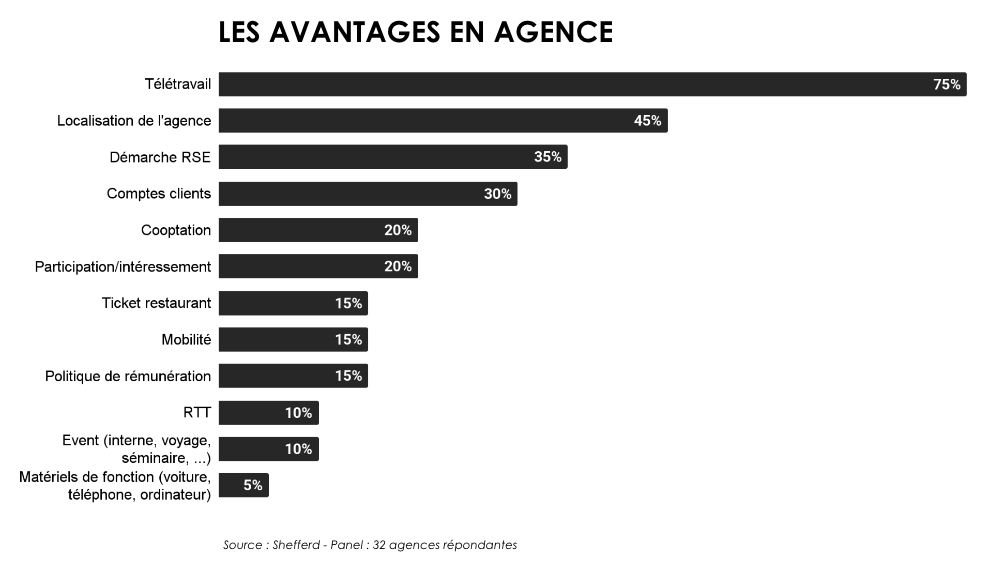
When we talk about employee benefits, we automatically think of meal vouchers, company health insurance, company phones or cars, extra days off, and so on. But over the past few years, the range of benefits has expanded significantly. Some have even become prerequisites for candidates, such as remote work.
The Hopscotch Group understood this very well and implemented a remote work charter that applies to all employees. Hopscotch tells us that beyond the 2 days of remote work per week that have become the standard today, the group offers the possibility to spend 2 weeks within another agency of the group. As for We are Social, a similar policy has been put in place. It consists of granting 8 days per month of remote work that the employee organizes as they wish in agreement with their manager. “A week of remote work in a vacation home is possible”, explains Benoît de Kanel, HR Director at We are Social. The agency goes even further by offering a flat rate to its employees to cover remote work expenses. It has also implemented the “We are Social passport”, with the opportunity to meet teams abroad for 2 weeks. Employees can then work from Dubai, Sydney, London or Milan. Upon arrival, traveling employees are supported and have a mentor in the host agency with a proper onboarding process. Since the creation of this passport, 40 employees have benefited from it. And already 8 since January 2023.
Dentsu took a different approach by offering flexible remote work. Employees therefore have the choice to work in the office or from home in Clermont-Ferrand, Rennes or Montpellier. Similarly, no imposed days—everyone does as they wish. Dentsu’s finding: ultimately the average number of remote work days is the same as what is usually imposed, around 2 days. But each employee has the choice and it’s this freedom that matters to Dentsu.
The same observation applies to OP1C, which also practices flexible remote work. The agency calculated the remote work time of its employees, and it currently stands at 1.74 days per week. OP1C decided to let employees define their own rhythm based on their needs, “Remote work is neither an obligation nor a constraint; it must be a tool. If an employee needs to concentrate or has a plumber appointment, they have the opportunity to organize their schedule thanks to remote work”, explains Lionel Damm, General Manager of OP1C.
Another benefit is intra-group mobility. Mobility within an agency is a considerable asset for employees who can develop within the same group. We are Social offers career pathways to its employees within the group, allowing them to propose a richer and more unique career journey. OP1C, for its part, offers career development plans within the agency for at least 3 or 4 years. Lionel Damm explains that they train interns within the agency and then offer them employment and career progression over several years. The objective is simple: to guarantee employee commitment while also ensuring the level of expertise desired by the agency.
Employee referral programs implemented by agencies are assets to highlight among the benefits offered. We are Social proposes this and even provides additional compensation for each referred person, ranging from €250 to €2,000 depending on the profiles. 70% of agencies say they use referrals for certain recruitments, but don’t think to communicate this additional advantage to their employees.